5-2 Case Study: Alibaba.com: a Born-again Born Global Firm?
Ananda Carvalho Pimenta ananda.pimenta@usp.br
FEA-USP/SP , Brasil
Marcus Joswig marcusjoswig@gmail.com
rsität Darmstadt , Alemania
Moacir de Miranda Oliveira Junior mirandaoliveira@usp.br
FEA-USP/SP, Brasil
Roberto Sbragia rsbragia@usp.br
FEA-USP/SP, Brasil
Dimensions on Born-Global Firms´ Case Studies
Revista Eletrônica de Negócios Internacionais (Internext) , vol. 12, no. i, pp. 48-61, 2017
Escola Superior de Propaganda e Marketing
Received: 05 March 2016
Accepted: 14 March 2017
Abstract: The objective of this enquiry is to analyze which dimensions and attributes are discussed in born-global firms' example studies presented by the literature and in practice. For these two specific objectives were proposed: i) identify the dimensions used to study the built-in-global firms; ii) identify the main concepts applied to such dimensions. Both analyses are based on cases studies addressed in the literature and practical case studies. This research is classified as exploratory and contains a content analysis. Furthermore, information technology was based on a pick of academic manufactures obtained on ISI Web of Cognition database focusing on born-global firms' case studies. The results demonstrate that the main issues regarding the born-global firms are found in an aligned perspective with the theory fifty-fifty when the article is focused on a particular manufacture. As a contribution, this study presented the list of dimensions and attributes that can be used as a reference for complementary discussions regarding the built-in-global example studies or even theoretical propositions. The composition of example studies, which provides a broad overview for the researchers, tin can be considered equally an additional contribution of this article.
Keywords: Built-in-global, Case study, Concepts.
Resumo: O objetivo desta pesquisa é analisar quais são as dimensões due east atributos discutidos em estudos de caso de empresas born-globals, apresentados na literatura e na prática. Para estes dois objetivos específicos, foram propostos: i) identificar every bit dimensões utilizadas para estudar as empresas built-in-globals; ii) identificar os principais conceitos aplicados a essas dimensões. Ambas as análises são baseadas em estudos de caso abordados na literatura due east em estudos de caso práticos. Esta pesquisa é classificada como exploratória eastward contém uma análise de conteúdo. Além disso, baseou-se em uma seleção de artigos acadêmicos obtidos no banco de dados ISI Spider web of Cognition, com foco em estudos de caso de empresas born-globals. Os resultados demonstram que as principais questões relativas às empresas built-in-globals são encontradas em uma perspectiva alinhada com a teoria, mesmo quando o artigo é focado em uma determinada indústria. Como contribuição, este estudo apresentou a lista de dimensões e atributos que podem ser utilizados como referência para discussões complementares sobre os estudos de caso born-globals ou mesmo proposições teóricas. A composição dos estudos de caso, que fornece uma visão geral para os pesquisadores, pode ser considerada como uma contribuição adicional deste artigo.
Palavras-chave: Born-global, Estudo de caso, Conceitos.
ane. Introdution
For management in general and strategy in specific, the internationalization theme has evolved prominently. Its conceptual development has been supported by the duality of theoretical and practical discussions. In this particular effect, information technology is understood that the economic-social insertion can exist seen as leading in establishing new modus operandi and new perspectives for firms, or as stated by Johanson and Vahlne (1990 p. 22) that house "internationalization is embedded in an e'er-changing world". Furthermore, the authors Jones and Coviello (2005, p.291) presented the following characteristics to distinguish internationalization patterns "(1) way of transference (cross edge business models); (ii) place of transference (state); (iii) time at which it occurs". Thus, resulting in the research problem of this commodity: which key aspects are relevant when discussing the internationalization model of built-in-global firms?
Because this context, this research's overall objective is to analyze which dimensions and attributes are discussed in born-global firms case studies presented past the literature and in practice.
To achieve this objective, the following specific objectives are proposed: i) place the dimensions used to study the built-in-global firms; ii) identify the principal concepts applied to such dimensions; both analysis are based on cases studies addressed in the literature and practical case study.
2. Background
2.1 Internationalization
Johanson and Vahle (1977) started an explicatory arroyo to the internationalization of companies by creating the so called Uppsala model. Due to the applicability and success of the model, it was constantly updated (JOHANSON; VAHLNE, 1990 and JOHANSON; VAHLNE 2009) and lays the foundation for this research.
The model's beginning step describes the company'southward decision in which mode they should enter a new marketplace. The entry mode choice should be done by analyzing the costs and risks based on the characteristics of the specific new target market versus its ain resource. This procedure has to be reviewed again subsequently each step of the internationalizing procedure. With more noesis of a foreign markets its risks are lowering which again leads to a stronger commitment to the market. This 'Process Theory of Internationalization' describes the company's gradual approaches of entering international markets, which tin can take up to decades of constantly further involvement
Some other influence on the risks related to internationalization is the so called "psychic altitude". This attribute is related to the social surroundings and the gap betwixt the company'due south experience and noesis and the market place itself. Over time, it was constitute that information technology the proximity can, amongst others, exist increased past the raise of mod advice technology. According to the researchers, the company'due south acting in a strange market allows the firm to increment the cognition of the market by its gathered feel. This then leads to a greater "commitment" to the marketplace, which tin can exist understood as more investments. With more investment, the learning bend gets steeper which can, in a adjacent stride, lead to more investments. The company is stride-by-stride increasing its foreign activity. However, the exact pathway of each company is very individual and always depends on human decisions. In the review of the model by Johanson and Vahlne in 1990, the authors focus more on the network concept. A company can build its new international relationships by the following three approaches: "(one) Through the institution of relationships in country networks that are new to the firm, i.e. international extension; (2) through the development of relationships in those networks, i.due east. penetration; and (iii) through connecting networks in different countries, i.due east. international integration." (JOHANSON; VAHLNE, 1990 p. 20)
It is relevant to signal that the network referred to by the researches is related to the suppliers, customers (east.chiliad. final or sales-channels) and commercial partners. "A firm's success requires that those dimensions are well established" (JOHANSON; VAHLNE, 2009, p.1415). As well, co-ordinate to Johanson and Vahlne (2009, p.1416), "network knowledge development is more than learning from the agents, but also involves the interaction between a buyer'due south user cognition and a seller's producer knowledge which generates new knowledge" for the firm. This widely appreciated Uppsala model describes the process of internationalization itself. However, it does not explicate the characteristics that are required or benign for the process. These influences tin can exist separated into internal and external attributes.
Internal characteristics that have influence on the company's functioning can exist summarized nether the Resources Based View (RBV), which describes the visitor as a bundle of "tangible and intangible" (WERNEFELD, 1984, p.172) resources, which are responsible for the "competitive advantage" of a visitor (TEECE; PISANO; SHUEN, 1997, p.509). Fletcher (2001, p.26) summarizes the most important internal factors establish in internationalizing theory equally being "(1) direction characteristics and (2) organizational characteristics".
Management characteristics include, amidst others, the international experience accumulated in their life, like time spend overseas or the country of birth. Other characteristics are related to the managers' knowledge like familiarity with the culture and international business practices. Furthermore, planning orientation and having a strategic or proactive approach were considered to be important for successful internationalization.
Organizational characteristics that were considered to be important were the willingness to develop products for oversea markets, to research oversea markets and to fund the international activities. Furthermore, the technological advantage, which is related to the nature of the production was mentioned in the literature.
External incentives can exist understood under the industrial organizational theory, which argues that a firm's success depends on its strategy, which is adamant by external factors (SCHERER; ROSS, 1990). The external environment is responsible for the pressures that let a company suit to the threats and opportunities (COLLIS, 1991). External factors mentioned in the "traditional" internationalization approaches were on i hand related to the aids and incentives of the governments. On the other manus, as well domestic too as oversea demand and competitiveness play an important part in the decision making of the company.
According to the researchers, Oviatt and McDougall (1994b) defined 4 types of international new ventures, which have an adjusted early internationalization strategy. The showtime dimension is related to the scope of activities of the value concatenation, distinguishing between few and many internationally coordinated activities of the value chain. The 2d aspect is the marketplace diversity, which differs between few, and many entered markets. Equally a event, The framework proposes the following types i) import/export get-go-ups, two) multinational traders, three) geographically focused offset-ups and iv) global showtime-ups. Global outset-ups are here defined as companies, which enter diverse markets and feature an internationalized value chain. In order to address the question when a company is considered to internationalize early, the authors Jones e Coviello (2005) examines farther the importance of time to this research stream. They argue that "incorporating time as a master conceptual dimension is essential to sympathize entrepreneurial internationalization", due to the fact that "the business firm itself and internationalization behavior are too functions of time" (p.290). A company is subject to its passing and it influences the environs. In a way "that the internationalization process is related, direct and cyclically, to numerous performance aspects of the firm performance" (p.299).
To summarize the traditional explanation of internationalization, a traditional firms' internationalization process can be considered as a "stage" model, where firms evolve from sequential stages from selling in the "psychically and geographically close markets" to an ad hoc production site that attends the demand away. (KONTINEN; OJALA, 2012 p. 6).
2.2 Built-in Global
The phenomenon of the born-global was first discussed in the business literature over twenty years ago, when in 1993 McKinsey & Co. published a study where they identified a group of Australian manufacturers who were exporting simply two years after being established. Since and then it has gained practitioners and academic attention over the last decades. Its relevance can be recognized past the focus of the book "Globalization and Pocket-size and Medium Enterprises" released by OECD - Organization for Economical Co-functioning and Development - in 1997 that presented chapters discussing built-in-global firms.
Born-global firms are in a way challenging the mainstream theories of incremental or gradual internationalization (OVIATT; MCDOUGAL, 1994). Different authors argue that the 'born global' firms' phenomenon contradicts the Uppsala gradual process of internationalization (BELL, 1995) past pointing out that 'built-in global' firms internationalize speedily and intensively, almost from their inception.
The built-in-global concept - according Knight and Cavusgil (2004) - is defined every bit business firms that, from their founding (or very near of that), seek superior international performance based on the sales originated from multiple countries. To those authors,
"The distinguishing feature of these firms is that their origins are international, every bit demonstrated by management's global focus and the commitment of specific resources to international activities (…) these early adopters of internationalization begins with a global view of their markets, and develops the capabilities needed to attain their international goals at or near the firm'due south founding. (KNIGHT e CAVUSGIL, 2004 p 124, 125).
Looking at the born-global companies from the resources based view, Oviatt and McDougall (2005) summarize the difference betwixt the traditional models and the born-global stream by a shift of the capability's importance. Whereas organizational knowledge is considered crucial in the traditional approaches, born-global firms depend more on the private managerial knowledge. Some researches bespeak, "The internationalization of the born-global firms is driven by entrepreneurial owner managers with a global mindset which allows them to face the marketplace adversities and to seek for opportunities" (WEERAWARDENA ET AL., 2007, p. 299). Especially the cosmos of networks is of importance for the newly founded companies (FREEMAN; EDWARDS; SCHRODER, 2006). According to Chetty and Campbell-Hunt (2004) the knowledge of the entrepreneur tin substitute the company'due south missing experience. The lack of organizational knowledge tin can even be seen equally a facilitator of the rapid internationalization process (AUTIO et al. 2000).
Also, external factors demand to be taken into account. Authors like Aspelund and Moen (2005) suggest that born-global firms search for international markets as a forced movement to answer to an insufficient domestic market, which tin be regarded equally constraining the business. Furthermore, external developments are creating an surround that allows new ventures to internationalize speedily. Examples are the globalization of markets, due east.g. international value chains and the homogenization of buyer preferences and technological advances similar the information & advice technologies, international logistics and modern production methods (KNIGHT; CAVUSGIL, 2004).
Although born-global firms have become a prominent expanse of research, there exercise not withal be clear definitions when a start-up, or an early internationalizing company tin exist considered as built-in-global. The most prominent characteristics to allocate a born global visitor is firstly the time when the company starts to go abroad and secondly the scale of the strange operations. Kuvalainen et al. (2012) establish in an evaluation of built-in global definitions that the maximum internationalization time is to exist between two and three years. The calibration of international activities is, depending on the author, between 25% and 75%.
Ane frequent criticism toward the born-global model is based on the fact that the percentage of sales that are supposed to be external might have no relevance depending on the country or even the continent that the company is based in (LUOSTARINEN AND GABRIELSSON, 2006, p.780). Some researches bespeak that the internationalization of the "born-global firms is driven by entrepreneurial owner-managers with a global mindset which allows them to face up the marketplace adversities and to seek for opportunities" (WEERAWARDENA ET AL., 2007, p. 299). And it is considered that "the internationalization process of born-global firms is a matter of learning through networks" (…) "in a procedure that is neither planned nor linear". (SHARMA; BLOSTERMO, 2003, p. 750).
According to Tuppura et al. (2008), "built-in-global firms are supposed to be highly proactive and able to enter new markets rapidly in terms of geographical areas and/or new products and services". (2008 p. 485). Entrepreneurial owner-managers of born global firms assume the "development of innovative products" as a consequence of "close relationship and comprehension to their customer". (MORT; WEERAWARDENA; LIESCH, 2012, p. 556-557).
For Andersson and Wictor (2003) the built-in-global firms' institution modes are a strategic choice, which can be the total opposite of traditional models (…) and usually consist of a planned rapid internalization through several modes of entry. In a manner, that the strategy is built but based on firms' resources. Equally stated by Mort, Weerawardena and Liesch (2012, p.551) "the ability to develop and configure innovativeness as marketable products provides a compelling source of competitive reward and superior performance in born-global firms".
Knight and Cavusgil (2004 p. 124) propose that "future researches should aim at deepening our understanding of early adopters of internationalization, which represent a widespread, ongoing trend." that can be seen across industries and trading countries.
three. Methodology
This research is classified as exploratory every bit information technology focuses on a better understanding of the built-in-global internationalization concepts, due to clarification of concepts and ideas (GIL, 2002; GIL, 2008). It takes the course of a literature review since its training is achieved using existing papers analysis, similar in academic articles (GIL, 2002).
The main advantage of a literature review lies in the fact that, faced every bit a starting betoken, the researcher can cover a broad range of his object of study in a much wider way than direct search. This is particularly of import when the research problem requires widely dispersed data (GIL, 2008).
The literature review is not limited to echo or summarize what has already been said about the subject, but its purpose is to reach new approaches and innovative results (MARCONI; LAKATOS 2003). To address the miracle of born global companies, publications presenting case studies were taken into account.
Additionally, to the literature review, the authors conducted an interview with a consultant to capture the practical perspective regarding built-in-global companies, in order to appraise the alignment between theory development and management practices.
3.ane Information gathering
A search was conducted on 06.fifteen.2015 in the ISI Web of Knowledge database and the following filters were applied:
Title: built-in global
· Topic: case written report
· Search domain (spider web of scientific discipline categories): social sciences
· Area research focus (web of science categories): business concern economic science
· Blazon of publication (document types): article
· Publication language: English
· The search results were applied to a critic review for the relevance of the articles presented based on the citation data presented by ISI.
Manufactures with no citation (zero) were disqualified from the selection due to the focus on presenting relevant academic discussions.
3.2 Information assay
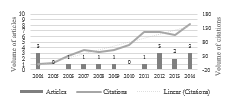
Nautical chart 1.
Total articles per year
elaborated by the authors, based on the inquiry
A content assay was conducted with the selected articles, to identify the researchers' and scholars' focuses when conducting instance studies regarding the born global firms – "considering that the content analysis focuses on identifying the indicators enabling one to deduce that the reality is different from the message" (BARDIN 2011, p. 384).
The content assay was made considering all the relevant discussions in the following steps: the authors mapped the problems presented inside the commodity, identified similarities in the content, defined the cluster for the similar bug and defined them equally an attribute. The attributes were aligned considering the principal topics embedded to finally define the dimensions used in the research.
4. Results
This department aims to present the results obtained in the enquiry. Every bit described in the methodology, the qualitative analysis conducted in this research was to capture the primal dimensions of born-global firms' internationalization discussed in the case studies presented in the pick.
The ISI Spider web of Knowledge search resulted in 19 articles. These articles had commendation numbers between none and over iii hundred. After excluding articles with no citation, which guaranteed to present just the relevant discussions in the field, xvi academic articles were called for farther analysis. After this qualification, the 16 articles were read in order to confirm that the pick was aligned with the purpose of this study (APPENDIX I) and to place the main dimensions and attributes presented in the born-global firms' instance studies.
3.iii Quantitative Analysis
In a next step, the analysis was conducted on the selected sample to identify aspects of built-in-global firms' academic research and the respective problems. Since the main objective of this report is to identify the dimensions presented by the born-global firms' case studies, it can be seen in Chart one that oldest publication in the selection was made in 2004.
Even though the first word regarding the born-global house phenomenon was conducted in 1993, the first case study regarding this topic was published xi years subsequently. Even so, a positive trend of citation numbers can be identified which perchance indicates that the topic is gaining more attention from researches and scholars.
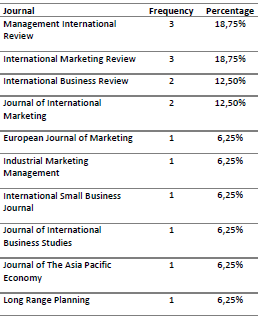
The Table one presents the article frequency past periodical, in which can exist seen that, within the 10 journals that covered the topic of born-global firms, the academic journals Management International Review (focus on research in the fields of international direction) and International Marketing Review had the greatest number of relevant articles.
Tab. 1
Article frequency past journal
elaborated by the authors, based on the research
4.one Qualitative Assay
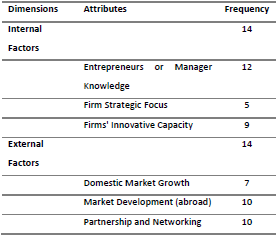
The Table 2 presents the dimensions and attributes identified in on the selected articles - the complete list of attributes identified past the researches is presented at APPENDIX 2. In this tabular array, information technology tin exist seen that although the total number of internal and external factors are equal, the attributes do not replicate the proportionality (14 articles present the same number of citations for Internal and External factors). The near often mentioned attributes for internal factors are "entrepreneurs or manager cognition" indicating the owners' and managers' relevance for the procedure of internationalization of a built-in-global firm. When considering the External Factors, both attributes "marketplace development abroad" and "partnership and networking" present the same high frequency, what can possible indicate the foreign market perspectives are extremely correlated to the network and the partnership built in the new marketplace.
Because that the selection contains only empirical articles that aim to talk over and test hypothesis regarding one or more than born-global firm concepts, it was observed that the perspectives captured by the instance-studies, although plural, present concepts that are aligned with a global perspective of built-in-global firm model.
Tab. ii
Attributes' frequency
elaborated past the authors, based on the research
When considering the internal factors, the selected articles have the following propositions:Entrepreneurs or Director Cognition
The born-global theorists Chetty and Campbell-Hunt (2004) found that the "entrepreneurs are accepted to operate in a global economic system. This characteristic is strengthened past the accelerate of communication technologies. Those attributes are then used to develop strategies and maintain the relationships required by an accelerated procedure of internationalization". (2004, p.62)
• Born-global firms unremarkably are founded by entrepreneurs with a "potent international perspective". They usually have a strong customer focus with high quality products. Furthermore, they heavily utilise the firm's "marketing competence" in gild to be successful outside of their abode market place. (KNIGHT; MADSEN; SERVAIS, 2004 p. 647)
• For Knight and Cavusgil (2004) "the international entrepreneurial orientation of born-global firms reflects a managerial mindset focused on innovation that leads the firm to pursue strategies aimed to maximize international performance". (2004, p.136)
Firm strategic focus
• According to the authors Chetty and Campbell-Chase (2004) due to the fact that "focus and pace of internationalization are established past competitive imperatives to seize a leading position in niche or emerging markets", it'due south necessary "to emphasize the role of strategy in the internationalization process" (2004, p.63).
• Kalinic and Forza (2012) indicated that born-global firms have "farthermost flexibility" and are able to "adjust ever-changing external weather". (2012, p.697)
• "Born-global firms demonstrated a highly-developed ability to identify and mobilize resource from external sources, enrich and extend existing internal resources and to recombine these in novel and elaborated means with a strategic purpose". (MORT; WEERAWARDENA; LIESCH, 2012 p. 552)
Firms' innovative capacity
• "Cognition that fosters unique products development also allows built-in-global firms to serve specific markets well, giving rise to increased marketplace share and sales growth and supports superior international performance". (KNIGHT; CAVUSGIL, 2004, p. 131)
• For the authors Knight, Madsen and Servais (2004) "the strategy elements of product quality, marketing competence and production differentiation are a direct influence to born-global organizational operation". (2004, p. 654)
• Ofttimes, according to Trudgen and Freeman (2014), built-in-globals "operate in specialized markets in highly technical industries with their innovative products in a way that fiscal returns tin be delayed equally a scenario of the fourth dimension and resources needed to brainwash the market about the value of their products". (2014, p. 570)
Considering the external factors, the example studies mentioned the following characteristics to be beneficial for the creation of built-in-global firms:
Domestic market
• "Built-in-global founders perceive the world every bit one marketplace and thus do not confine themselves to a unmarried country", this happens due to the fact that "they recognize the limited importance of the domestic market from the firms' inception", mainly because "they may have either a pocket-size domestic market or no domestic marketplace". (CHETTY; CAMPBELL-Chase, 2004 p. 61)
• For Freeman; Hutchings; Chetty (2012) born-global firms potentially perceive the "downturns of the home market equally a trigger to seek foreign locations that can exist used to first fluctuations in demand, as much every bit changes in the home market regulatory environment". (2012, p.441)
• "The stride of born global house internationalization occurred considering of the entrepreneurial drive and interpretation of the founder(southward) also as the modest size of the domestic market place" (p.704) and its "maturity". (p.706) (TAYLOR; JACK, 2013)
Marketplace development (away)
• Born-global firms "followed international market changes and competitors' deportment then adult their responses, acting like a market driven firm due to production characteristics in the industry". (KOCAK; ABIMBOLA, 2009) p. 447)
• Born-global firms' effective institutional bridging starts with "developing detailed social and cultural knowledge about the target markets, such equally (1) knowledge about potential customers to customize products and services; (two) cultural knowledge nearly the norms and practices that underpin commercial transactions, and (3) noesis of the legal and regulatory environment, both formal and informal". (KARRA; PHILLIPS; TRACEY, 2008, p.448)
• The born-global firm'southward most adult resources are the "capability to create new markets, generate demand and position itself as a leader in those markets". This power is further strengthened by the "strong capacity to innovate and consequently be a starting time-mover in the markets". (SEPULVEDA; GABRIELSSON, 2013, p. 799)
• For Trudgen; Freeman, (2014, p.571) the born-global firms are "aware (…) of the challenges of psychic distance", which "reflects a longer-term business organization perspective, prolonging the amount of time born-global spent in the early international entry/ development phases".
Partnership and networking
• For "born-global firms, the influence of networking adequacy is not restricted to touch on on capital requirements and management skills but is instrumental in developing innovative products, in locating markets beyond national borders and in international marketplace performance" (MORT; WEERAWARDENA, 2006, p.568)
• Built-in-global "strategies that utilize partners are favored because they enabled partnership advantages providing market place access and finish customer credibility". (GABRIELSSON; GABRIELSSON, 2011, p.97)
• For Hagen and Zucchella (2014) "the born-global firms' social networks work as an accelerator" (p.519) and "a significant proportion of the opportunity for exploration and exploitation is to be found by born-global firms in partnerships, which represent a key asset in this companies' resources base". (p. 523)
To strengthen the critical view regarding the born-global firms' dimensions and attributes, the authors discussed the born-global firms' model with a practitioner who supports firms in their early stages of the internationalization procedure. This should be regarded as a validation of the instance studies (APPENDIX III). This additional case – considered exploratory by the authors, "offered the opportunity to explore the limits of the descriptions and explanations developed" in the article choice's cases (SWANBORN, 2010, p. 105)
The main aspects brought by the consultant regarding the built-in-global firms were (i) the internationalization requires profound noesis and grooming about the target market, (ii) the decision of becoming a born-global firm usually considers the external factors equally much as the internal factors in a combined view, (iii) the entrepreneurs sympathize that it is crucial to establish a local infrastructure / relationship (clients, suppliers, distributors, investors), (iv) the internationalization adoption is aligned with the firm strategic focus, (five) the born-global firms' entrepreneurs are relevant to the internationalization model and have some distinct characteristics (agreement the strange market, for example) and (vi) born-global firms are resources-constrained firms in the beginning of the internationalization process.
5. Decision
This research's overall objective was to analyze the dimensions and attributes discussed in born-global firms' case studies, in order to extend the agreement of this miracle. To accomplish this objective two questions were answered: i) identify the dimensions used to report the built-in-global firms; ii) identify the main concepts applied to such dimensions; both analyses are based on cases studies addressed in the literature and practical case studies.
To properly conduct this enquiry, a categorization was proposed that allowed the authors to map the issues in a standard approach. Equally a upshot, the main issues presented in the sample were clustered in one of the six attributes that were consolidated into ii dimensions.
The results demonstrated that the main issues regarding the born-global firms are developed in perspective that is aligned to the literature and to the management practice experienced by consulting firms. The authors considered the singled-out relevance presented by the attributes used in the enquiry that in a way captures the main perspectives/agents that support the built-in-global house internationalization. Furthermore, the authors understood that this alignment occurs as a result of the post-obit context: (i) the built-in-global firm model has not reached a mature phase; (2) the plurality of the issues derive from the fact that the case studies are built to analyze different purposes in multiple industries.
As a contribution, this study presented a list of dimensions and attributes that tin can be used equally a reference for further discussions regarding the built-in-global firms' instance studies or even theoretical propositions. The limerick of case studies can be considered as an boosted contribution developed by the authors by providing a broad overview for the researchers.
The study's limitations can be considered to exist the rather low number of selected manufactures that might have some influence on the dimensions and attributes proposed.
References
§ ANDERSSON, S., WICTOR, I. (2003) Innovative internationalism in new firms: born globals – the Swedish case, Periodical of International Entrepreneurship, 1, 249-276
§ ASPELUND, A., MOEN, O. (2005) Small international firms: typology, performance and implications, Management International Review, Vol. 45 No. 3, pp. 37-fifty.
§ AUTIO, Eastward., SAPIENZA, H.J., ALMEIDA, J.One thousand., 2000. Effects of historic period at entry, knowledge intensity, and imitability on international growth. University of Management Journal.
§ Bong, J. (1995) The internationalization of small figurer software firms, European Journal of Marketing, Vol. 29 Iss 8 pp. 60 – 75
§ CHETTY, Due south. AND CAMPBELL-Chase, C. (2004) A strategic arroyo to internationalization: a traditional vs a ''Born-Global'' arroyo, Journal of International Marketing, Vol. 12, No. 1, pp. 57–81.
§ COLLIS, D.J. (1991), A resource-based analysis of global competition: the case of the bearings industry, Strategic Direction Journal, Vol. 12, pp. 49-68.
§ FLETCHER, R. (2001). A holistic approach to internationalisation, International Business organization Review, Vol. x, No. one, pp. 25-49.
§ FREEMAN, Due south., EDWARDS, R., SCHRODER, B. (2006). How smaller built-in-global firms use networks and alliances to overcome constraints to rapid internationalization. Periodical of International Marketing, Vol. xiv, pp. 33-63
§ FREEMAN, S; HUTCHINGS, Thou; CHETTY, S. Built-in-Globals and Culturally Proximate Markets. Management International Review. 2012
§ GABRIELSSON, M; GABRIELSSON, P. Internet-based sales aqueduct strategies of built-in global firms. International business review,. 2011
§ GIL, A. C. Como elaborar projetos de pesquisa. 4. ed. São Paulo: Atlas, 2002.
§ GIL, A. C. Métodos e técnicas de pesquisa social. 6. ed. - São Paulo: Atlas, 2008.
§ HAGEN, B.; ZUCCHELLA, A. Born Global or Born to Run? The Long-Term Growth of Born Global Firms. Management International Review,. 2014
§ JOHANSON, J. & VAHLNE, J.-E. (1977) The internationalization process of the firm: A model of knowledge development and increasing foreign market commitments. Journal of International Business Studies, Vol. viii, No. 1, pp. 23–32.
§ JOHANSON, J. VAHLNE, J. (1990) The Mechanism of Internationalization, International Marketing Review, Vol. 7 Iss 4 pp.
§ JOHANSON, J.VAHLNE, J-E. (2009). The Uppsala Internationalization Process Model Revisited – From liability of foreignness to liability of outsidership. Periodical of International Business Studies, Vol. 40, No. 9, pp. 1411-1431.
§ JONES Thou., COVIELLO, Northward. (2005) Internationalization: Conceptualizing an Entrepreneurial Procedure of Behavior in Time, Journal of International Business Studies, Vol. 36, No. 3, pp. 284-303
§ KALINIC, I; FORZA, C. Rapid internationalization of traditional SMEs: Between gradualist models and born globals. International Business organization Review ,2012
§ KARRA, N; PHILLIPS, N; TRACEY, P. Building the born global firm – Developing entrepreneurial capabilities for international new venture success. Long Range Planning.2008
§ KNIGHT G., CAVUSGIL, S. (2004) Innovation, Organizational Capabilities, and the Born-Global Firm, Journal of International Business Studies, Vol. 35, No. two, pp. 124- 142.
§ KNIGHT, Yard; MADSEN, T; SERVAIS, P. An inquiry into built-in-global firms in Europe and the USA. International Marketing review, 2004
§ KOCAK, A; ABIMBOLA, T. The furnishings of entrepreneurial marketing on born global performance. International Marketing Review. 2009
§ KONTINEN, T, OJALA, A (2012), Internationalization pathways amongst family unit-owned SMEs International Marketing Review, vol. 29, no. 5, pp. 496-518., 10.
§ LUOSTARINEN, R., GABRIELSSON, K. (2006) Globalization and marketing strategies of born globals in SMOPECs. Thunderbird International Business Review, 48(vi), 773–801.
§ MARCONI, M. A.; LAKATOS, E. M. Fundamentos da Metodologia Científica. v ed. São Paulo: Atlas, 2003.
§ MORT, G.; WEERAWARDENA, J. Networking capability and international entrepreneurship – How networks part in Australian built-in global firms. International Marketing Review. 2006
§ MORT, G. WEERAWARDENA J., LIESCH, P. (2012), Advancing entrepreneurial marketing, European Journal of Marketing, Vol. 46 Iss three/iv pp. 542 - 561
§ OVIATT, B., MCDOUGALL, P. (1994a) Toward a theory of international new ventures. Journal of International Business Studies, 25(one), 45-64.
§ OVIATT, B., MCDOUGALL, P. (2005) The Internationalization of Entrepreneurship. Journal of International Business Studies, Vol. 36, No. one, pp. 2-8.
§ OVIATT, B., MCDOUGALL, P. (1997) Challenges for internationalization procedure theory: the case of international new ventures. Management International Review, 37, 85–99.
§ OVIATT, B., MCDOUGALL, P; SHANE, Due south. (1994b) Explaining the formation of international new ventures: The limits of theories from international business organization research. Journal of business organisation venturing ,Nov 1994, Vol. ix Upshot 6, p469, nineteen p.
§ SEPULVEDA, F.; GABRIELSON, M. Network development and firm growth: A resources-based study of B2B Born Globals. Industrial Marketing Management .2013
§ SHARMA, D., BLOMSTERMO, A. (2003), The internationalization process of born globals: a network view, International business review, 12, 739–753
§ SWANBORN, P., Case study research: What, Why and How? 1. ed. London: Sage, 2010.
§ TAYLOR, Yard; JACK, R. Understanding the pace, calibration and pattern of firm internationalization: An extension of the "born-global" concept. International Small Business concern Periodical. 2013
§ TEECE, D., PISANO, 1000. AND SHUEN, A. (1997), Dynamic Capabilities and Strategic Management. Strategic Direction Journal, Vol. eighteen, No. 7, pp. 509–533.
§ TRUDGEN, R.; FREEMAN, S. Measuring the Performance of Built-in-Global Firms Throughout their Development Process: The Roles of initial Marketplace Option and Internationalization Speed. Direction International Review, 2014
§ TUPPURA, A. et al. (2008) Linking cognition, entry timing and internationalization strategy, International Business organization Review 17, 473–487 Vol. 43, No.5, pp. 909–924.
§ WEERAWARDENA, J., SULLIVAN MORT, Thou., LIESCH, P., KNIGHT, G. (2007) Conceptualizing accelerated internationalization in the born global firm: a dynamic capabilities perspective, Periodical of Globe Business organization, Vol. 42 No. iii, pp. 294-306.
§ WERNERFELT, B. (1984), The Resource-Based View of the Firm. Strategic Management Periodical, Vol. 5, No. 2, pp. 171–180.
Alternative link
https://internext.espm.br/internext/article/view/356/299 (pdf)
Source: https://www.redalyc.org/journal/5575/557561285004/html/
0 Response to "5-2 Case Study: Alibaba.com: a Born-again Born Global Firm?"
Post a Comment