Volkswagan Plants to Make Bus Again
Next year, the Volkswagen bus will brand its return to the U.s.a., this fourth dimension with electric underpinnings.
The 2024 Volkswagen ID.Buzz, congenital using VW's electric MEB platform, is the latest in the visitor'due south long history with rider and cargo vans.
Hither'due south a history of the VW Charabanc.
Blazon ii
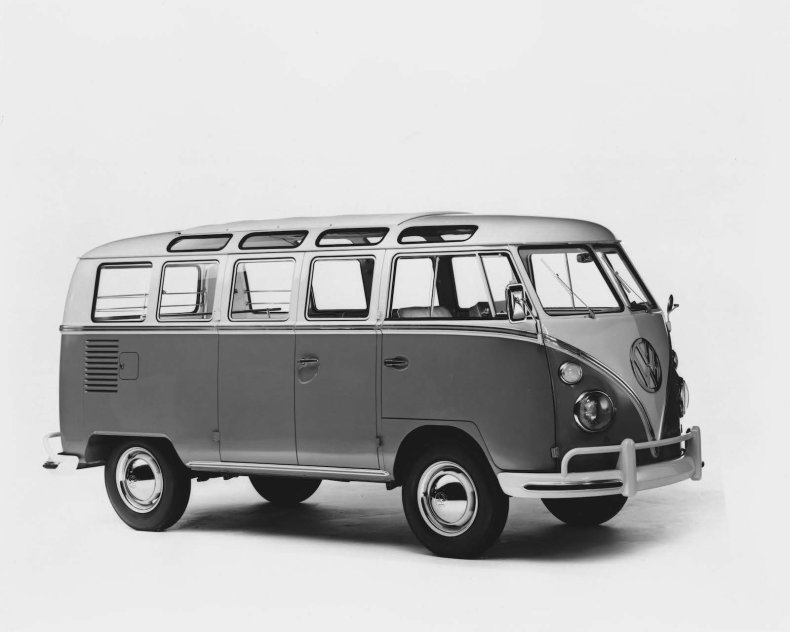
In 1946, Dutch VW importer Ben Pons traveled to Wolfsburg, Germany to buy a handful of Blazon 1s, more usually known as the Beetle. While there, he saw a custom-built factory vehicle called the Plattewagen. He later sketched the bus, the company's engineers further refined the design, and the Type two was put into production in 1949.
The outset generation Type 2, or Autobus as it was chosen in the U.S., was fabricated from 1950 to 1967. They could besides be had every bit unmarried-cab utility pickups or the Sunroof Deluxe upscale version.
The bus featured a rear-mounted engine and 23 windows.
During the '60s, the Type two was an unlikely focal point of U.S. trade policy as different countries fought over the import and export of chickens.
U.S. mail service-World War II product of chicken led to a precipitous increase in exports to Europe. European countries complained that the U.Southward. was overloading their markets and harming domestic chicken producers.
The European Economic Customs, a precursor to the European Marriage, imposed tariffs on U.S. chicken in 1963. A brusque time afterward, President Lyndon Johnson responded with tariffs on several products, including light trucks.
The VW Type 2 was classified as a light truck, and as a result the van'southward presence was reduced significantly in the U.S. market place.
The second generation debuted in 1967, with the most pregnant difference between it and the offset generation being the switch to a unmarried drinking glass panel for the windshield.
During that second generation, the bus became a countercultural touchstone every bit a symbol of the hippie movement and surf civilization.
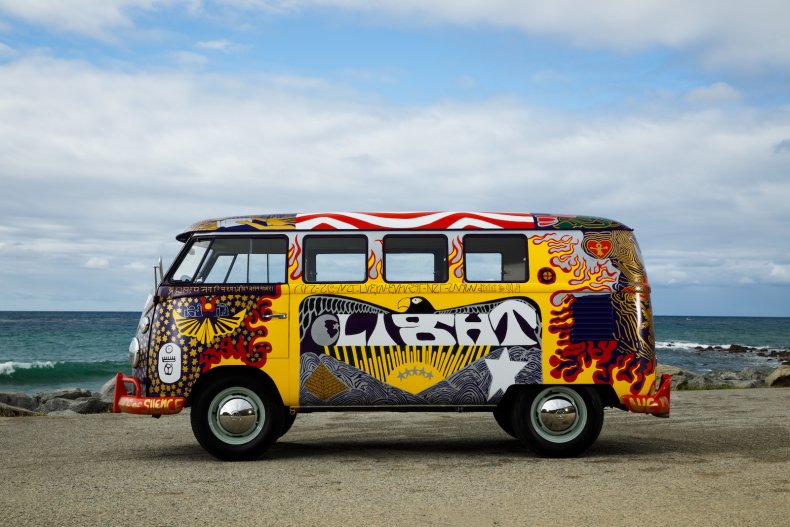
In 2019, a replica of the original "Light" bus, a Blazon 2 painted by Dr. Bob Hieronimus that appeared at Woodstock and became a symbol of the era, was shown off at a Bus enthusiast's coming together in California.
Three years prior, Hieronimus and documentarian John Wesley began a search for the original van. When information technology couldn't be plant, they bought an identical Double-decker and recreated the work.
Hieronimus was originally asked to paint the van in 1968.
Type 3
That was followed by the Vanagon for the third generation, which held that classic VW van shape until product ended in 2002. It was the terminal VW van with an air-cooled engine, which was somewhen phased out for a nevertheless-rear-mounted boxer-blazon engine.
Type 4
From 1992 to 2003, the Type four was exported to the U.Due south. as the EuroVan. Four models of the EuroVan were sold throughout that run: the 7-seater EuroVan CL, GL and GLS, EuroVan MV with rear-facing second-row seats, the EuroVan MV Weekender and EuroVan Camper.
The EuroVan Camper was a Westfalia conversion that included a popular-top roof, seating for 4, 2 beds, and additional items to enhance the camping experience.
Microbus Concept
Just as VW was catastrophe production of the Type 2, the company unveiled the Microbus concept in 2001.
Billed as a "design written report for the world of tomorrow" while besides hearkening back to the traditional Blazon 2 styling, the van was scheduled for release in the American market in 2004. The project was delayed and eventually scrapped that year.
Bulli and BUDD-eastward
In the 2010s, VW displayed a few all-electrical concepts based on the Microbus pattern.
At the 2011 Geneva Motor Testify, the Bulli concept debuted, which was equipped with an 85-kW motor that was capable of a visitor-estimated 186 miles of range.
Bulli was also the showtime vehicle to showcase the visitor's then-forthcoming MEB electric vehicle platform.
That was followed upward with the BUDD-e concept in 2016, which had a VW-stated range of 233 miles.
Neither concept fabricated it to production.
ID.BUZZ
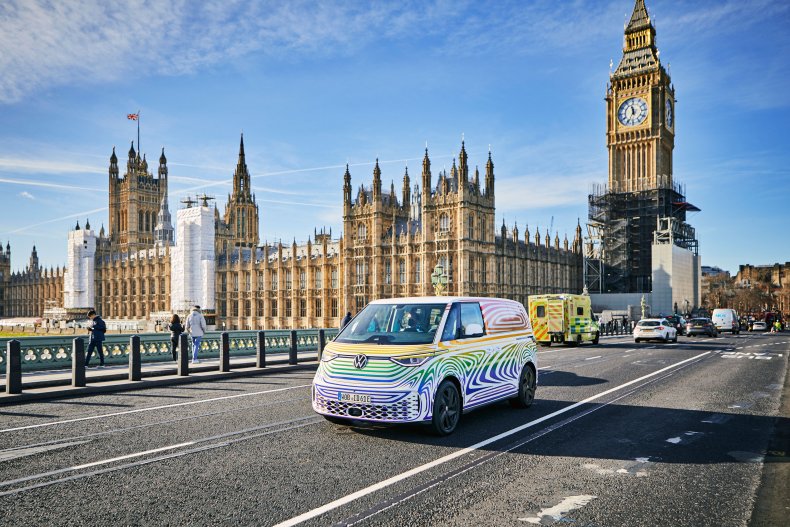
VW unveiled the latest all-electric edition of the van every bit a concept machine in 2017. At the time, the company indicated that it would brand an all-wheel drive version with a 111-kilowatt-hour (kWh) battery pack and a rear-wheel drive model with an 83-kWh battery.
The adjacent year, an ID.BUZZ Cargo concept was shown with an estimated payload chapters of 1,760 lbs.
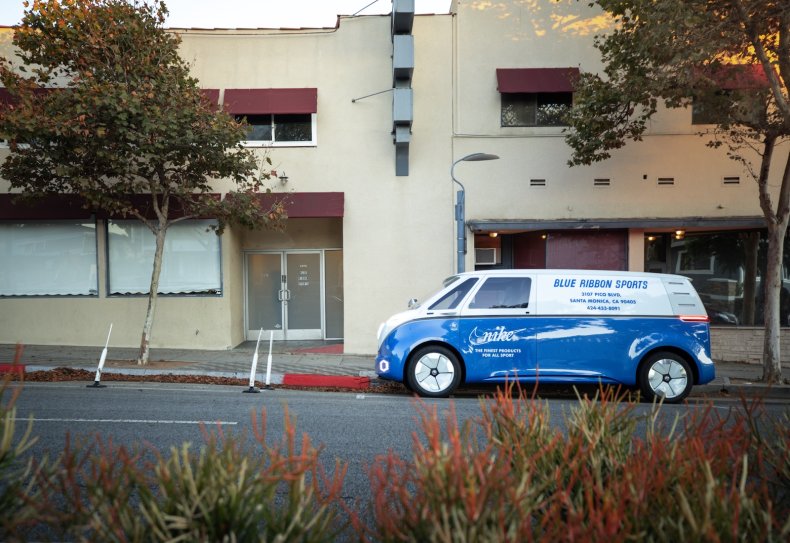
A Cargo epitome was then put to use in the U.S., as VW partnered with Nike to display information technology at multiple Nike shop locations across the country.
On March 9, the jitney will be shown publicly for the first time at the Due south past Southwest conference in Austin, Texas.
In the lead-up to that, the company says that versions of the battery will accept a capacity of 48 kWh and 110 kWh. Those capacities are VW-estimated to 200 miles and 340 miles of range, respectively.
The ID.Buzz is currently slated for release for the 2024 model twelvemonth.
Source: https://www.newsweek.com/2024-vw-idbuzz-ev-has-roots-bus-that-hit-streets-more-70-years-ago-1685012
0 Response to "Volkswagan Plants to Make Bus Again"
Post a Comment